
Overall Summary
Pregnancy Threatened – preparing for a decision to treat Polyhydramnios on Friday 2/12 7:30 am…with record snowfall predicted to begin Thursday afternoon.
The Details
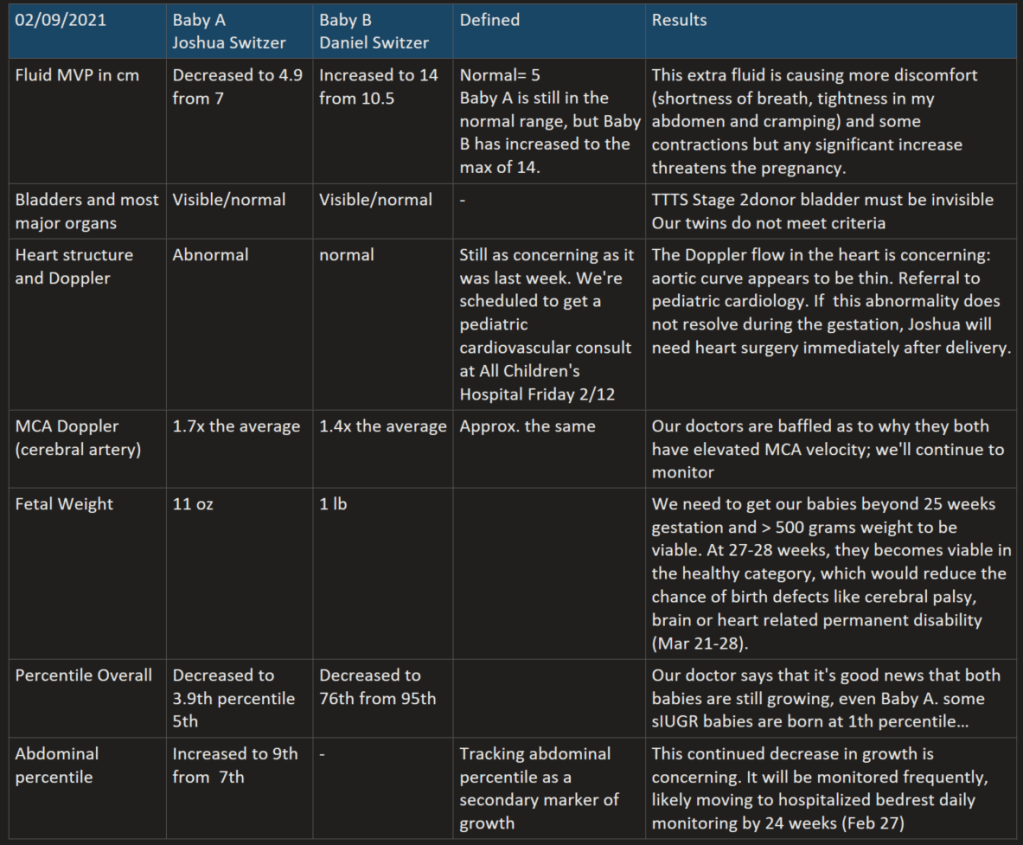
We had hoped for good news today but instead, we received more jarring news. Both babies’ Doppler studies indicate they both still have elevated blood flow rates in their cerebral arteries, which is usually indicative of anemia. But, they both aren’t showing any other signs of anemia so we’re going to continue to monitor this symptom to see if it leads somewhere. The growth numbers decreased in both babies: our large baby dropped from 95th percentile to 76 and our small baby decreased from 5th down to just under 4th. Our doctor says that it’s good news that they are both still growing and gave us some new goals. We need to get both babies beyond 25 weeks gestation and > 500 grams weight to be viable. At 27-28 weeks, they becomes viable in the healthy category, which would reduce the chance of birth defects like cerebral palsy, brain or heart related permanent disability. If we can get them to March 21 or out to March 28, delivery would be a better option than anything else should Baby A’s growth stop.
The most immediate concern is to manage the condition that could cause loss of pregnancy. Polyhydramnios is excessive accumulation of amniotic fluid surrounding a baby in utero. It threatens the pregnancy in many ways – premature labor, placental abruption, umbilical cord prolapse, and more. My cervix is finally showing signs of too much pressure/weight from the fluid as well, so any option to treat includes surgical suturing of the cervix to keep it from opening (cerclage) which will be removed at delivery. Right now the larger twin doesn’t seem to be suffering any expected negative effects from this excess fluid, but if it increases again, he will. I return this Friday to have my fluids measured again. We were told that if the amniotic fluid around Baby B increases, we must be prepared to make a decision to treat it.
Option 1 is to reduce the fluid by draining the excess amniotic fluid with a large needle (amniocentesis).
Pros: 1% chance of the procedure causing loss of pregnancy (spontaneous miscarriage).
Cons: This does not address the underlying or root cause of the excess fluid, so it will continue to build up again and need to be removed again. We can continue to drain the fluid with the same procedure repeatedly until we can deliver but choosing this path means we no longer have the option to do Fetoscopic laser photocoagulation (FLP) at any time.
Option 2 is to do FLP where our surgeon uses a laser to block the blood vessels that communicate between the twins. This newer method of managing sIUGR ensures that the connecting blood vessels do not cause harm to the normal twin, while allowing the smaller twin to continue at its rate of development.
Pros: It can address the underlying cause of the polyhydrops, preventing excess of fluid for the remainder of the pregnancy. It also allows the smaller twin a chance at continuing development. Additionally, this preserves our larger twin’s life, if our smaller twin doesn’t survive over the next 5-6 weeks.
Cons: 5% chance of the procedure itself causing loss of pregnancy/spontaneous miscarriage. Since the procedure seals off the blood flow between the twins that may be keeping the small twin alive, cutting off his access could result in fetal death if his placental share is not enough to sustain him. The only way to know if his placental share is enough is in hindsight; there’s no way to know before we do the procedure.
It’s likely whatever procedure we choose on Friday will override my appointment at All Children’s Hospital so we’ll have to reschedule the cardio consult. Oh, and the snowstorm, because hey, why not!?! Since I live 50 miles from the hospital, I’ve booked a hotel room less than a quarter mile from the hospital where the streets leading to the hospital should be cleared/plowed rather early in the morning so that I can drive to my appt. If the snow is impassable, I could likely walk to the hospital on Thursday morning (as long as I give myself plenty of time to waddle up the hill – lol). In all seriousness, most women dealing with TTTS or sIUGR have to do this drill by flying to Los Angeles, Cincinnati or Miami. We truly are fortunate to have one of the top surgeons for this particular “rare” complication in the same state, even during a snowstorm.
Thank You for Your Support
Thank you again for all of your support, sending healing and prayers our way. Many people have a visceral reaction to the word prayer, or any word used other than prayer. Here’s why I use the words I am using in this blog (and in real life). As a woman who studied the Christian Bible for almost half a decade in preparation to go to seminary and later studied at a theological university, I value people, and these people often hold diverse beliefs and come from diverse backgrounds. The most distilled statement I can craft is that I believe the most important command of my faith is to value others and find unity rather than division (I’d be happy to have a deep theological discussion offline about where I find the doctrine and scripture to support, but I will not digress here). More simply put, I treasure people: I have friends whose beliefs are Lakota, Jewish, Hindu, and many different denominations of Christian that they may as well be different religions. I also value my agnostic and atheist friends. I find science and faith in harmony not odds. The science, psychology and metaphysics of prayer is becoming well documented. A decade ago, Psychology Today cited just a few studies in an article that shared this:
“An interesting bit of science attached to this ethnocentric and geocentric evolution of prayer comes out of Duke University Medical Center, where a study found that, within a group of 150 cardiac patients who received alternative post-operative therapy treatment, the sub-group who also received intercessory prayer (they were prayed for) had the highest success rate within the entire cohort. The fascinating thing about the study is that it was double-blind – neither the researchers, nor those on the receiving end of the intercessory prayer knew that these patients were being prayed for — suggesting an intervening variable.” <https://www.psychologytoday.com/us/blog/enlightened-living/201007/the-science-psychology-and-metaphysics-prayer>
I’m sure there’s more studies and evidence out there for those interested in doing their own due diligence. My bottom line is this: we are all connected. When a human being sends out positive intent, healing light and love, blessings, or prayer, the metaphysical reciprocal resonance that has been demonstrated to exist between states of consciousness – specifically, casual states of consciousness (prayer, meditation and deep, dreamless sleep) — and the quantum field (what we like to call reality) described by quantum physics. As a treasured friend of mine once said, “if you’re not paying attention to metaphysics, then you’re just not paying attention.” So, whether you hang your hat on science or prayer, both or somewhere in between, I value you and I desperately need you to send whatever positive energy you can toward my unborn sons.
Another heart felt thank you to everyone following our journey. May it end in April or May with a big celebration.
 Switzer Twins