
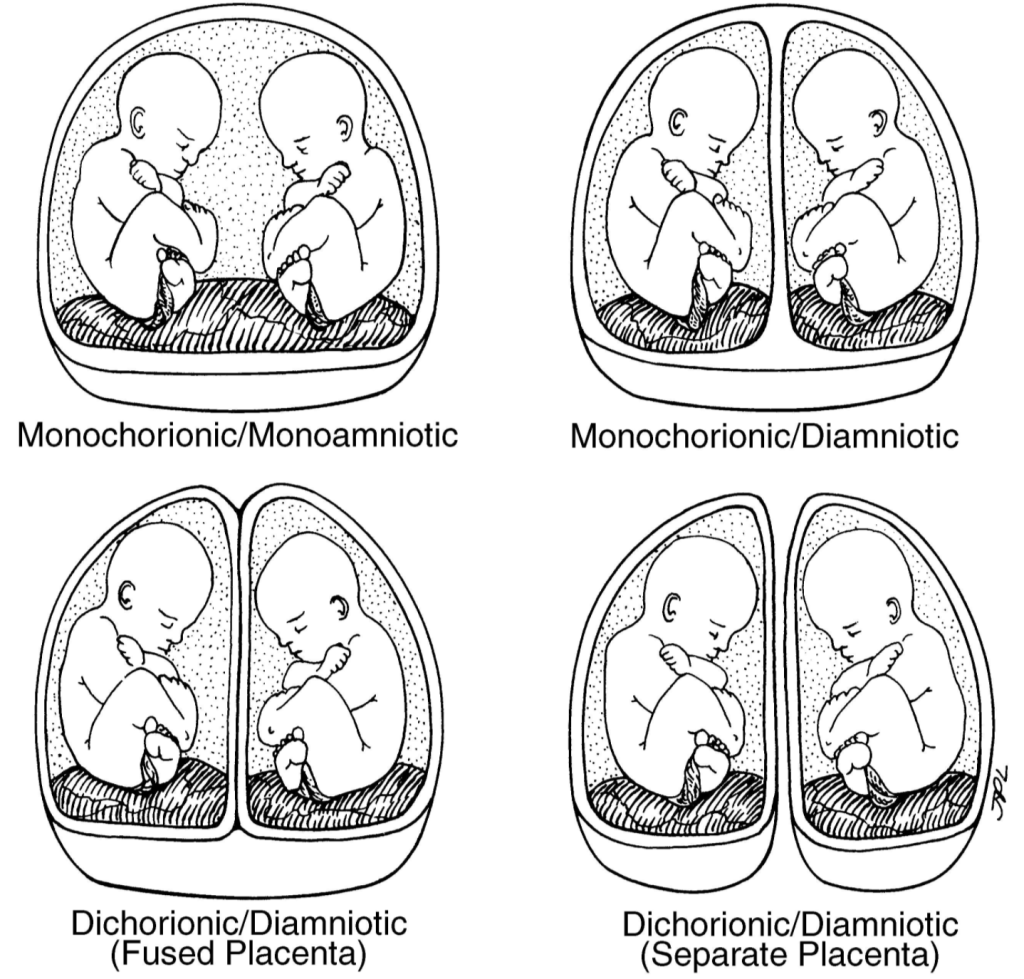
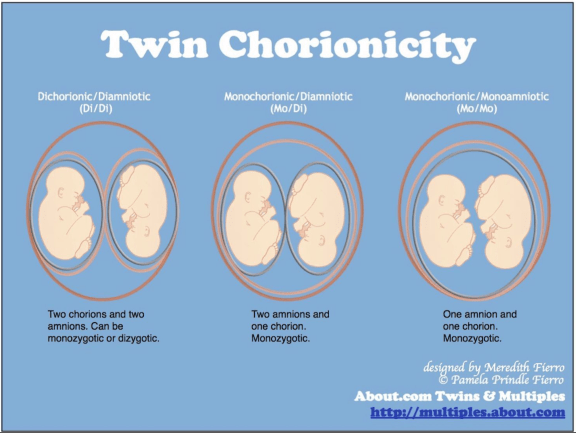
There are actually 4 types of twins. The type is determined by both the chorionicity (the outer membrane) and amnion (the inner membrane) and how the placenta is or is not shared. I found the best explanation at https://www.verywellfamily.com/twin-chorionicity-explained-4114659 . Visit that page for more.
“The terminology associated with a twin pregnancy can be confusing and overwhelming. Finding out that you’re having twins is just the beginning of an exciting experience. Along with adjusting to the idea of having two babies at once, there is a lot to learn. Here’s a guide to understanding these terms, and what they mean for the developing fetuses.
During a twin pregnancy, you may have heard the terms “Di/Di” or “Mo/Di” used to describe twins. These terms are used to classify and explain twin anatomy in the womb. Although it may sound like a lot of medical gobbledy-gook, they’re important concepts for parents because some twins are at risk for complications.
Let’s start by understanding the environment. In the womb, a fetus grows within its mother’s uterus. The placenta attaches to the wall of the uterus and serves the dual purpose of removing waste and providing nutrients to the fetus. It connects via the umbilical cord to the baby.
The fetus is enclosed in a fluid-filled sac surrounded by a thin membrane, called the amnion. A second membrane, called the chorion, surrounds the amniotic sac. Let’s break it down:
- Mo: Means one
- Di: Means two
- Chorion: Is the outer membrane
- Amnion: Is the inner membrane, which forms a sac filled with amniotic fluid containing the fetus”
What this means is that di/di twins or paternal twins and rarely have twin pregnancy complications because they each have their own placentas, amniotic sacs and chorions. Mono/mono twins are the most at-risk twin type and have a very low survival rate, because their umbilical cords tangle and terminate the pregnancy.
So for us, our twins are mono/di or identical twins, who developed from one embryo, that have the same outer membrane, separate amniotic sacs they share the same placenta and that is the root cause of most mono/di twin pregnancy complications. 80% of mono/di twins have rather normal gestations. That leaves 15-20% of mono/di twins who do experience complications.
 Switzer Twins