
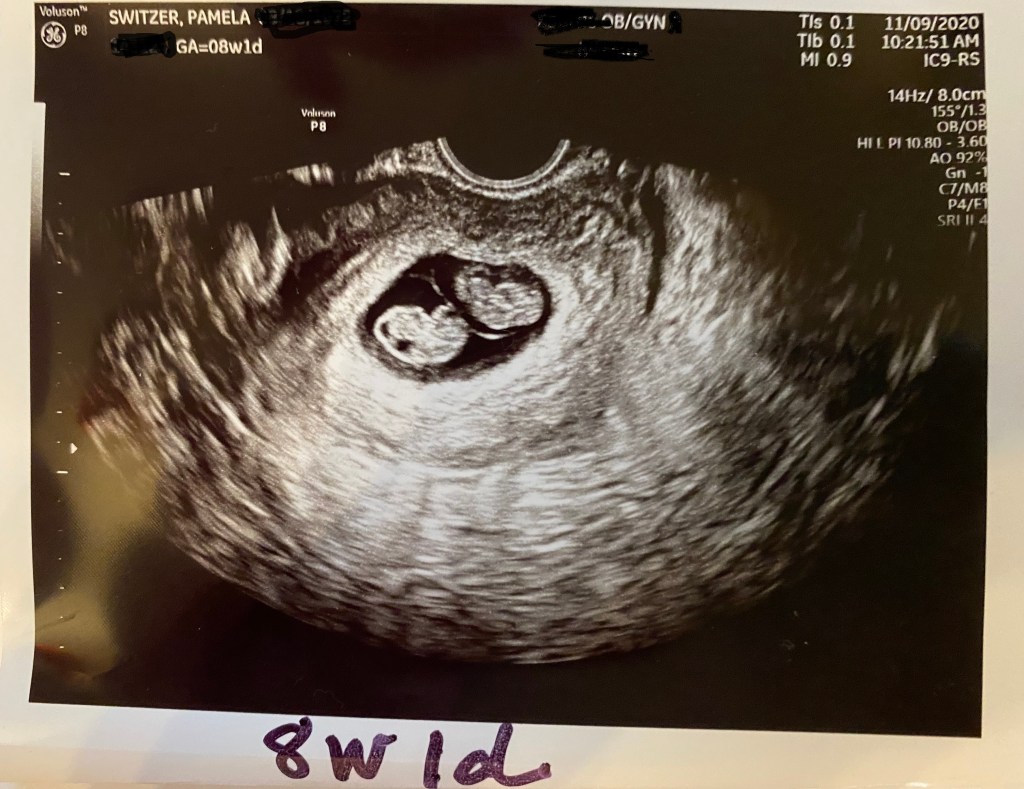
Identical in size and growing well. They’re perfect!
It was at my first regular appointment that I had my first sense of foreboding. Although we had discussed our plan for preeclampsia mitigation and transfer to Maternal Fetal Medicine who are all perinatologists, which is a fancy name for OBGYNs who specialize in high-risk pregnancy, I was unprepared for the anxiety I saw in the face of my OBGYN. This is the woman who admitted me to the hospital not once but twice on the verge of a stroke or heart attack. The first time at 31 weeks with severe preeclampsia that was untreated, completely ignored by my OBGYN at the time. Then she admitted me again directly from the NICO to the 5th floor with a preeclampsia flare up that sent my BP to 201/100 just a week after I delivered my son at 33 weeks. This is the doctor that saved my life twice. The look on her face was disconcerting. When I said, ” I thought our plan was to transfer me to MFM at the first sign of pregnancy induced hypertension (PIH) or HBP which would lead to preeclampsia?” She said, “our plan has changed: you’re carrying mono/di twins – we don’t even care for any mono/di twins in our practice, your history notwithstanding; we transfer them all immediately to MFM.” She went on to explain that while most mono/di pregnancies deliver near term with no complications, 20% have serious complications and she’d make sure I got the best care possible. I remember feeling confused and concerned when I left her office.
I went home and began researching like crazy. What I found on the internet was nothing short of harrowing. I copied urls and made notes. I read statistics that all seemed rather abysmal. I decided to be informed but prayed that my babies would be in the 80%. I readied myself with the facts.
What is the recommended timing for office visits for twin pregnancies?
Uncomplicated Twin Pregnancy Recommended Timing of Office Visits
| TWIN CLASSIFICATION | STARTING AT | OFFICE VISIT |
| Dichorionic-Diamniotic (Di-Di) | First prenatal visit 28 weeks 36 weeks | Every four weeks Every two weeks Every week until delivery |
| Monochorionic-Diamniotic (Mo-Di) | First prenatal visit 16 weeks 36 weeks | Every four weeks Every two weeks Every week until delivery |
Possible Complications
The scariest and most prevalent complication seemed to be Twin-to-Twin Transfusion Syndrome (TTTS). I read everything I could find by a reputable sources like Johns Hopkins and Children’s Hospitals across the US. There really isn’t a lot of information. From what I found there are only 8 or so fetal surgeons or specialists that treat TTTS in the entire US. Most people fly to get treatment. I was especially horrified to read that 5% of mono/di pregnancies are diagnosed with TTTS too far along for intervention resulting in fetal mortality. I learned that the earliest it can be diagnosed is 16 weeks and early intervention is the must successful. My plan is to be prepared with the proper questions when I go into each visit with my MFM perinatologist. I will not just “do what my doctor tells me to” like I did in my last pregnancy, when my concerns were ignored week after week while my BP rose untreated. That advice almost killed me and my baby. I’ll be vigilant and vocal this time. This time will be different.
 Switzer Twins