
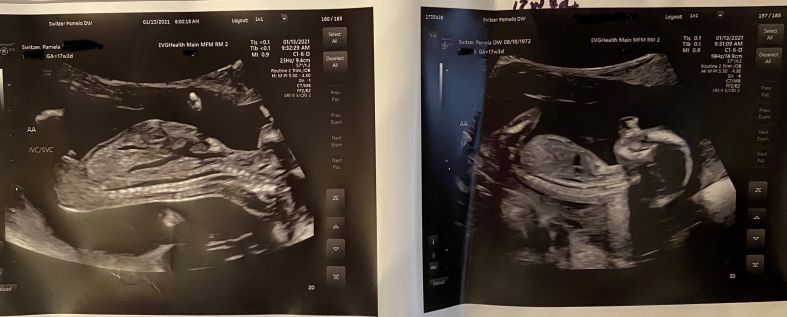
I was told to arrive with an empty stomach (no food or water after midnight) with a hospital bag in case we needed to go directly from the doctor’s office to prep for emergency surgery. I arrived tense and hoping for better news.
After a comprehensive ultrasound with Doppler studies (2.5 hrs) the specialist came in to go over the results. Everything about TTTS and related conditions is a study of blood flows, measured by the Doppler studies, and measurements – measurements of the babies to chart growth, measurements of the organs, measurements of the MVP fluid pockets, and measurements of the blood flows in and out of organs, the Medial Cerebral Artery (MCA), umbilical cords, and placenta. The amount of data our medical team must gather and review in order to understand were we are on that given day is staggering.
Today’s Diagnosis TTTS Stage0 with Expectant Management at this time
Our babies were borderline TTTS so since they didn’t meet the full criteria of Stage1, Dr. Walker called them Stage 0. In TTTS, one baby is large and called the recipient because that baby is getting more flow through the umbilical which causes many down stream symptoms like increase fluid around him and this increases pressures which result in stress on his organs and heart which lead to brain damage and heart failure. The smaller twin is called the donor because he is getting less supply through his umbilical, usually due to structural issues with his umbilical cord, poor umbilical cord attachment, and less placental share. These issues lead to symptoms such as too little amniotic fluid that further causes his bladder not to fill and disappear from ultrasound view, slow growth, and eventually Stage 5 which is death. One of our twins had too much fluid measuring MVP 9.6 (anything >8 is too much with 5 being normal) and our other twin measured at 3.9 MVP which was trending too little. For TTS Stage 1 the fluids must measure >8 and <2 – our babies are borderline and their bladders were both visible (TTTS Stage 2 when surgery is indicated is marked by the donor’s bladder disappearing). Their Dopplar studies showed elevated blood flows in small baby’s brain or MCA but not high enough to warrant surgery. To be clear, surgery isn’t advised until both babies are at lethal risk because surgery itself poses lethal risk. There is a 5% chance of spontaneous pregnancy termination from the invasive nature of the surgery. The placenta is very fragile and the vascular nature lends itself to rupturing when poked and prodded. The placenta is more mature and resilient at about 20 weeks, but becomes too mature and the vessels too large for surgery by 25-26 weeks. This window of approx. 4 weeks is really the surgery’s opportunity for the most successful outcomes. By successful, they mean cutting all vessels to Twin A so that when he dies, he doesn’t take Twin B with him. Surgery is targeted at preserving the life of one twin. Occasionally both twins survive, but usually a twin that has little placental share deteriorates and passes away after surgery.
When I asked what can I do? The only thing I can do is get more bloodflow to the uterus and take in nutrition. So. side-lying, horizontal rest begins now which increased bloodflow to the uterus and placenta, along with greatly increasing my nutrition to try to get more support to Joshua. My doctor has recommended I take in daily a minimum of 175g of protein and 2200-2500 healthy calories and 90 oz to 1 gal of water per day. That’s basically a diabetic diet with 3 additional 20-30g shakes (protein smoothies made with fresh fruits and greens) or Ensure Max 30g protein/4 g carb nutation drinks. Other than getting up for bio
In scouring the web for information on TTTS and TAPS, I found an amazing source of hope and heartbreak, and resources. The Twin to Twin Syndrome Foundation https://tttsfoundation.org/ . The found of this foundation experienced TTTS firsthand and lost her small twin Steven in 1989 because ultimately doctors at that time had little understanding the condition and no treatment options. Mary made a promise to Steven that he would be known and remembered and that she would find the answers. She has. Mary has connected mommas like me, bewildered by this “rare” diagnosis with the few specialists/surgeons who can treat it. She’s created support groups (using social media for good) for the newly diagnosed to help us manage our emotions, hear from the only other people who can truly understand this burden of fear and hope all mixed together, and the dynamic situation that forces us to be still and wait. This foundation has elevated awareness, resources, and success stories that bouy the spirits and raise the hopes of those of us who’ve already lost to the odd, the statistics that say “most mono/di pregnancies have no complications.” Statistics are of little comfort when they keep stealing your hope and forcing you into a smaller and smaller abyss. TTTS Foundation raises the battle cry to fight – fight with prayer, fight with hope, and fight with science. I cannot express how grateful I am for Mary and her promise kept. If you are looking for worthy nfp for donation this or any year, please consider one that helps save babies and supports women in their darkest hours.
The Details on our Diagnosis | further complicated
My Placenta
A healthy, typical placenta is anterior (located in the front of the uterus), posterior (the back of the uterus between the baby and mom’s spine), or fundal (on the top of the uterus). Most fetal surgeons won’t attempt a surgery on an anterior placenta for TTTS because it’s difficult to access from inside the uterus (think how does a laparoscopic laser instrument that is straight possibly curve 90 degrees to photo coagulate the inside of the front of the belly? Rarely will any fetal surgeon agree to attempt surgery on a mutli-sided placenta. I happen to have both – my placenta is anterior, fundal, and posterior with the area needed for surgical photo coagulation anterior.
Our Twins | Artery to Artery Anastomoses
Structurally, all mono/di twins share placental blood vessels and connections: they are truly sharing the same apartment living in different rooms. However, my twins have a large artery to artery anastomoses. This is essentially a large artery in Baby A’ s umbilical (my slammer baby) to large artery in Baby B’ s umbilical. This flow allows Baby A, my small twin, to garner nourishment from Baby B who is getting too much.
Our Twins | Doppler studies possible TAPS
Doppler studies are conducted on the blood flows in and out of all of the major organs, the umbilical, and placenta. Today’s Doppler indicated that the flow of blood through Baby A’s MCA was too high and might indicate early Twin Anemia Polycythemia Sequence TAPS.
Our Twins |Placental Share
At this time, Baby A has approx. 20-25% placental share while Baby B has 75-80%. The placenta continues to grow throughout pregnancy but is considered mature at 34 weeks so this very imbalanced placental share could improve or it could worsen. Should the small twin stop growing and deteriorate, this is an indication of placental insufficiency which is backward looking – we don’t know if the placental share he’s getting is insufficient to sustain his life. Based on his growth rate, it’s highly unlikely he would survive FLP.
Our Twins | Umbilical Cords and Cord Insertion
Baby B, our big baby, has a healthy 3 vessel umbilical cord with a secure connection to the placenta, and treelike vessels spawning into the placenta to give him adequate share of flows he needs. Baby A has a 2 vessel umbilical (less through put) along with a velamentous cord connection. This is when the umbilical cord abnormally connects more on the uterine wall along on the edge of the placenta along the chorioamniotic membranes, causing fetal blood vessels to travel unprotected from the placenta until they come together and reach the protection of the umbilical cord. Think of it as if you planted a plant on the rim of a flower pot; the roots would have to travel down the inside of the pot unprotected to make it to the soil for nutrients.
Current Treatment Path | Expectant Management
In a typical pregnancy the frequency is 4 weeks between ultrasounds until later in the pregnancy when it switches to 2 weeks. In mono/di twins the frequency is every 2 weeks. I’ll be monitored every 48-72 hours at this point. The goal of expectant management is for nothing to worsen, and to creep along toward viability which is 26 weeks or more gestation. We’re told to expect the longest our twins will gestate is 32 weeks. Expect that I will be hospitalized by 24 weeks, and expect preemies with long NICU stays. I’m incredibly fortunate to work for a company with values that support me caring for my family, allowing me to take leave and focus on this journey. I try to remind myself it is temporary, but the days are long and the weeks are longer.
 Switzer Twins